ANOTHER SIDE OF PARADISE, PART 3: PLUR1BUS (2025)
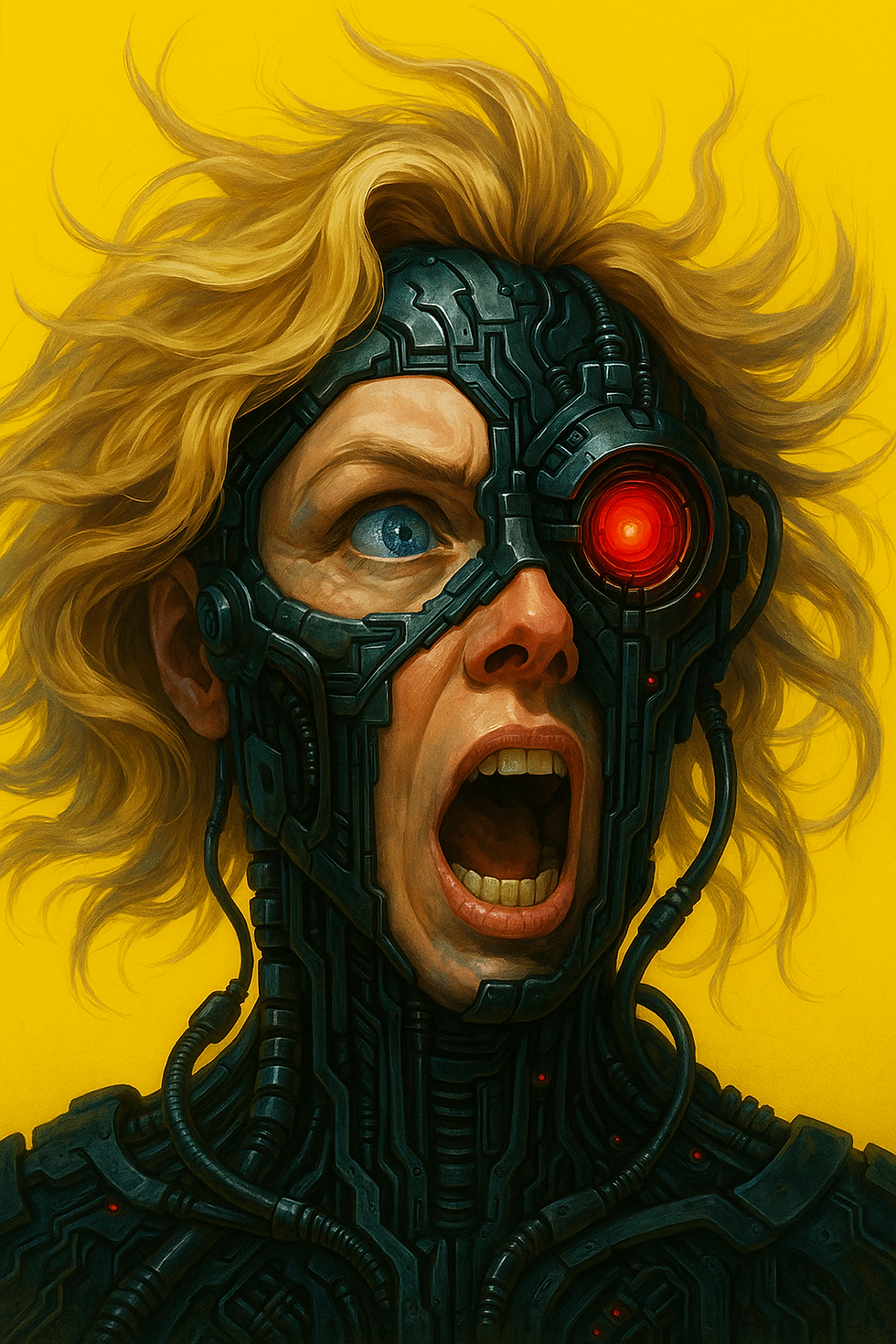
Author's Note: I didn't expect to wait until after the third episode to write the third installment of my thoughts about Pluribus. I wish I hadn't. The episode was a huge disappointment and made me wonder whether I'd invested too much hope in the idea that Breaking Bad wasn’t just a one-off burst of brilliance. (At some point I'll probably write about Better Call Saul, but suffice it to say that, for the most part, it felt like it was running on cruise control.)
The third episode of Pluribus felt like Sunday driving with a boring person behind the wheel. It eventually circled back to some of the interesting questions, but with no urgency and even less purpose. If we're going to take on the argument for nirvana, lean into it. Hard. If billions of people are waiting on you hand and foot, eager to please your every whim, why not put that premise under real pressure? “Get to work on ending this blasted human singularity.” Or at the very least: “Find the smartest scientists on Earth, put them in a state-of-the-art lab, and have them report to me.” And this business about not expecting the hand grenade to be real? How could she not expect that? The collective has already shown itself to be a humorless literalist, if nothing else.
I'll come right out and say it: this episode felt like an early draft, and it raises real concerns that the creative team may not actually know where this story is headed. Or—more worrying—that they've built a deeply incurious, flat “protagonist” who will ultimately decide she deserves the bliss of the collective consciousness. In other words, she’s being steered toward losing the argument that individuality is better. If that's where this is going, it isn’t much of a challenge. And it certainly isn’t much of a drama. Deep down, I think the cost of being individuals probably does outweigh the benefits—but that doesn’t make for compelling television unless the show is willing to wrestle with it, not sleepwalk toward it.
I'd be grateful if you kept all of this in mind if you read on ... Let’s talk now about where Pluribus might be going. This is my opportunity to play out some storytelling fantasies, most of them untethered to anything resembling evidence. An exercise in “here’s what would be cool to see,” in other words.
Overall, I’m imagining something dramatic. A sudden shift. Because as much as the early episodes flirt with the metaphysics of unity—the bliss of oneness, the great cosmic cuddle puddle—there’s simply no way the story ends as a heartwarming PSA for ego dissolution. After all, what’s the log line for that?
“A furious, self-medicating, emotionally sunburned novelist learns to overcome her broken identity by dissolving into the warm bath of universal consciousness.”
So, in the spirit of future embarrassment—and because the internet remembers everything, including the things we wish it wouldn’t—here’s my time capsule of possible futures for Pluribus. Unranked, unordered, unhinged.
1. PROTEIN, SLAVERY, or INCINERATION

Imagine that the “nirvana effect” was Phase One of a conquest strategy. First, you send out a beam of information that eventually turns your target species into harmless, tranquilized lambs—blissed-out, emotionally neutered, soft-focus eunuchs who apologize before breathing. Then, when your ships arrive, you harvest them for food, energy, industrial labor—pick your dystopian poison. They won’t meet you with resistance; they’ll meet you with, “Here, eat our brains first.” Or, “Let us brainstorm ways to pleasure you.” All this “drama” about the twelve people they’re trying to coax into the bliss bath would need to be ultimately irrelevant. But who knows—maybe the aliens are sticklers for process.
2. WE ARE BORG / I AM BORG / THEY IS BORG

Everyone becomes Pluribus except our heroine, who gets a front-row seat as humanity turns into the most aggressively benevolent hive mind in cosmic history. A species-wide uniplex of smiley, helpful, empathic drones who consume other civilizations not out of malice but because assimilation simply feels magnificent. Picture intergalactic Pleasantville with the moral imperative of a Roomba: sweep the universe clean of difference. The end result? A cosmos so uniformly harmonious it becomes spiritually (and narratively) intolerable. No conflict. No friction. Just star systems full of cheerful, emotionally supportive oatmeal. The universe doesn’t end in heat death—it ends in tedium. I could easily see Gilligan having fun with that: a show about humanity running screaming away from nirvana.
3. THE COLLECTIVE HAS MOOD SWINGS

What if the Pluribus isn’t evil, parasitic, or expansionist—just moody? Or vulnerable to all the mental disorders that come from loneliness? It tracks, given how obsessively it focuses on pleasing the remaining unabsorbed individuals. Once those separate entities are gone, you’re left with one solitary collective mind going quietly insane. Imagine a hive mind that experiences emotional weather systems: mass elation, mass despair, mass rage. A civilization wired into a shared neural cloud that periodically gets a bad software patch. One dark thought, one intrusive impulse, one corrupted memory—felt by everyone at once.
4. THE COLLECTIVE FORKS ITSELF

Unity sounds great until someone inside the unity disagrees. What if Pluribus undergoes a schism—a hive-mind civil war? Two factions emerge. Version A: Oneness means universal compassion.Version B: Oneness means eliminating anything that disrupts the signal—including unassimilated humans. Cue psychic street fights, telepathic espionage, and our protagonist caught between dueling hive minds like an ant trapped between colonies. Very Gilligan: moral complexity inside what looks, from the outside, like a monolith.
5. THE COLLECTIVE WANTS A BODY

A hive mind made of people is powerful. A hive mind that wants a single, physical body is terrifying. Imagine Pluribus deciding to build—or grow—a single organism large enough to house its consciousness. A planet-sized host. A bio-engineered avatar. A larval god. Humanity becomes both neuron and nutrient. This taps into the same ancient instinct that made Lovecraft afraid of the ocean.
6. THE COLLECTIVE GETS ADDICTED TO US

Maybe the hive mind needs new human minds and their individual knowledge and sensory experiences the way humans need dopamine. Maybe our emotional volatility, our memories, our heartbreaks and humiliations, become narcotics to it. What starts as bliss becomes dependency. Maybe it even kicks people out to gather new experiences and then reabsorbs them after making their lives a horror show—just to savor the fresh emotional data. Disturbingly plausible. Very us.
To every place of entertainment we go with expectation and desire of being pleased; we meet others who are brought by the same motives; no one will be the first to own the disappointment; one face reflects the smile of another, till each believes the rest delighted, and endeavours to catch and transmit the circulating rapture. In time, all are deceived by the cheat to which all contribute. —Samuel Johnson. Idler #18 (August 12, 1758)
“We assimilate species to improve quality of life for all.” — Seven of Nine (speaking as Borg), “Scorpion”


Comments